Your Patients Are Already Generating the Data. Are You Using It?
Written by Amissa Health
Perimenopause doesn’t announce itself cleanly. It arrives as 25 overlapping symptoms, brain fog that makes recall unreliable, and patients who’ve already been dismissed by two other clinicians before they walk through your door.
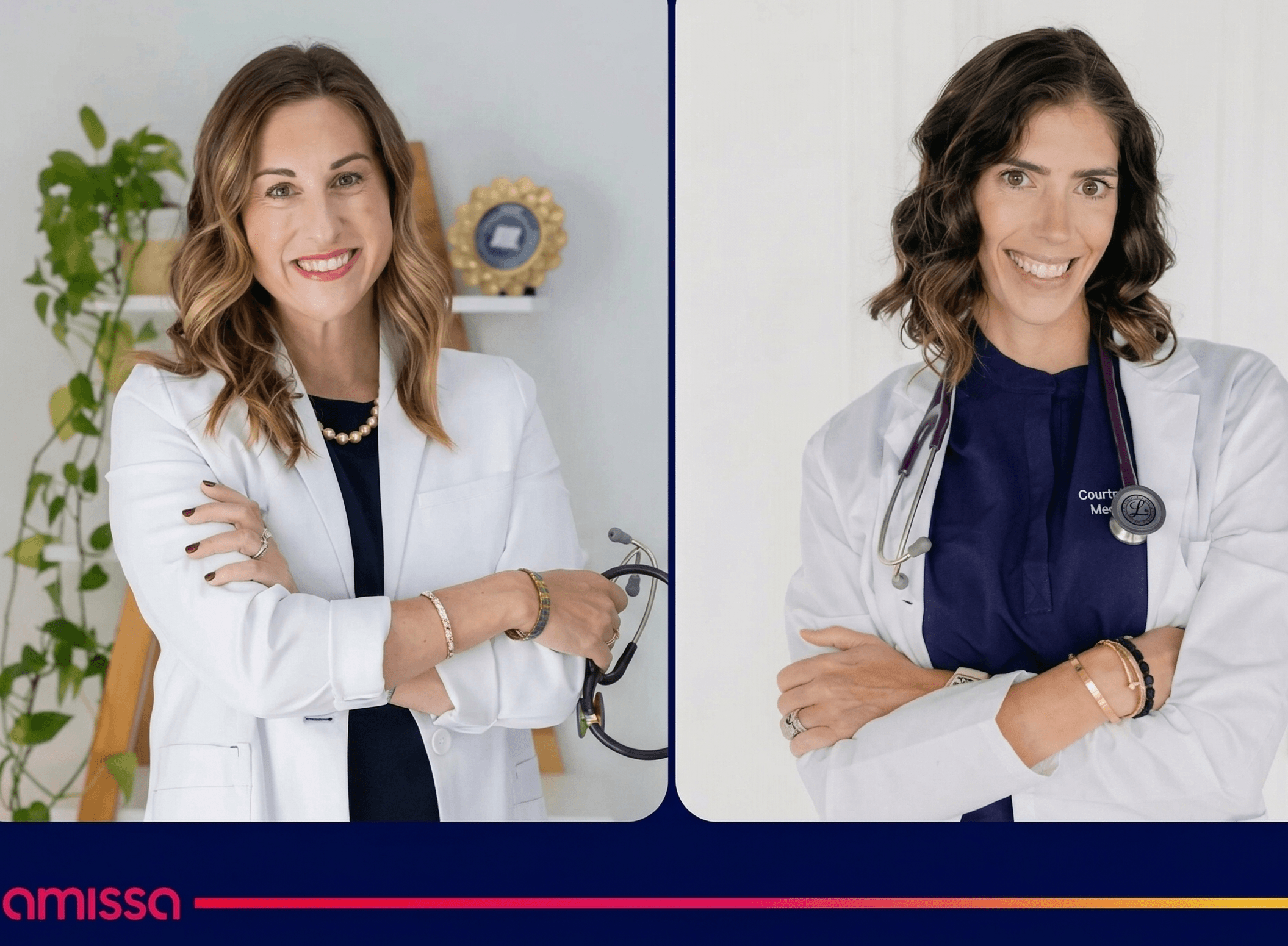
That’s the reality two women’s health nurse practitioners — Dr. Jackie Piasta of Monarch Health in Marietta, Georgia, and Dr. Courtney Shihabuddin of Empowered Wellness in Ohio — have been navigating for years. Both run specialist practices. Both have built their workflows around data. And both have found that the most transformative thing they can offer their patients isn’t a new prescription — it’s a mirror.
We sat down with Jackie and Courtney for a candid clinical conversation about what it actually looks like to translate symptom data into better care. The insights below are especially relevant for practitioners heading into NPWH’s Menopause in Motion conference this April — because this is the work the field is moving toward.
The Problem with Recall-Based Visits
Ask a perimenopausal patient how she’s been sleeping, and she’ll give you her best guess. Ask her about her mood last week, and you’ll get a heavily edited version filtered through how she feels right now. That’s not a character flaw — it’s brain fog. It’s the defining clinical challenge of perimenopause care.
“Women can come in with 25 different symptoms, and your brain is about to explode because you’re already running behind, or you only have a certain amount of time to get through things. I preach methodology.”
— Dr. Jackie Piasta, Monarch Health

Dr. Piasta’s answer to the chaos of the menopause visit isn’t more questions. It’s a structured approach built before the patient ever arrives. Pre-visit screeners. Validated tools like the Menopause Rating Scale. A specific ask: “Name your three top symptoms, three top goals. What do you need to accomplish today to leave here feeling like you made progress?” Dr. Shihabuddin echoes the same principle from a different angle. Her patients often come in having been dismissed elsewhere. They’re skeptical. They’ve been told their symptoms are “just aging.” The first thing she has to do is validate what they’re experiencing — and that validation is infinitely more powerful when she can show it to them in a chart.
“It’s a real luxury to be able to objectively look at data when trying to come up with a symptom curve or track how care is improving over time. It helps us say: you’re telling me this, but your data is showing that.”
— Dr. Courtney Shihabuddin, Empowered Wellness
Perimenopause Has No Lab Test. It Has Data.
This is the clinical reality that separates perimenopause from most other conditions practitioners manage: there is no blood test that confirms it. The STRAW+10 criteria are research-based and largely dependent on cycle changes — but not every woman’s perimenopause announces itself through her period. Many are on long-acting reversible contraceptives. Some skip the cycle changes entirely. And labs are actively discouraged in clinical settings.
What’s left is pattern recognition. And that’s exactly where longitudinal data becomes indispensable.
“There’s no test that our patients can go in and say, ‘test me for this.’ It’s all about pattern recognition. It’s a clinical, symptom-based diagnosis. So what better way than having those symptoms tracked?”
— Dr. Jackie Piasta, Monarch Health
Dr. Piasta shared a recent example that stopped the room: a patient who reported that her “mood had been all over the place.” When Dr. Piasta pulled up the symptom data, she could see that every single time the patient had logged a mood symptom, her heart rate had spiked the day before — consistently, over three weeks. That’s the kind of insight that doesn’t come from a 20-minute intake. It comes from continuous data.
“I was in the appointment and I was like, oh my god, look at this data. Every time, multiple times over the course of three weeks, it happened every single time before she marked mood.”
— Dr. Jackie Piasta
She used that data to inform a dosing decision — specifically, whether and when to upcycle hormone therapy. The data wasn’t a nice-to-have. It was clinical input.
The Wearable Data Your Patients Are Already Generating Here’s the thing: most of your patients already have the data. They’re wearing Oura Rings. Apple Watches. Garmins. They’re seeing low readiness scores and know they’re not sleeping, but they don’t know why. And they’re absolutely not connecting it to their luteal phase. That’s the opening. As Dr. Piasta puts it, the conversation practically starts itself:
“I’ll just see patients for their first visit and see them wearing an Apple Watch and say, do you wear that every day, and what do you do with that? And, oh my gosh, let me talk to you about this awesome app that is literally built for our conversation today.”
— Dr. Jackie Piasta
Dr. Shihabuddin describes the clinical value in similar terms. What she’s looking for is the domino effect: start progesterone, watch sleep improve in the data, see energy improve next, see mood follow. That sequence — visible over time in a chart — does something a verbal check-in can’t: it gives the patient evidence that the treatment is working before she’s fully feeling it.
“When we start, say, progesterone, and then their sleep improves, and there’s a domino effect — their energy is better, their mood is better — that really helps validate that what they’re doing is truly improving their overall health.”
— Dr. Courtney Shihabuddin
Both practitioners noted that the data is also a retention tool. When a patient can log into an app and see that she’s not logging symptoms — because she has fewer to log — that’s a tangible representation of clinical progress. It’s the aha moment that keeps her engaged with her care plan.
What “Tracking Burden” Actually Looks Like — and How to Reduce It
Every practitioner knows that adding a new step to a patient’s routine is a friction point. Perimenopausal women are, in Dr. Piasta’s words, “overstressed and overstretched.” Asking them to do more is a hard sell.
The reframe that both practitioners have landed on is simple: symptom tracking isn’t about adding a task. It’s about making the visit count.
Validated screeners like the Menopause Rating Scale can be completed before the visit, not during it, so the appointment itself is spent on care, not intake.
Symptom logging takes less time when it’s connected to a tool that already integrates wearable data. The patient isn’t starting from scratch.
The Likert-scale structure means patients can quantify improvement, even when they feel like nothing has changed. Dr. Piasta’s framing: “Your night sweats were a 4 out of 4. Now they’re a 2 out of 4. That’s massive improvement.”
The data travels. Dr. Shihabuddin downloads the PDF before appointments and loads it directly into her EMR — and when referrals are needed, she includes it with the referral packet as clinical context.
Both practitioners run practices where time is genuinely limited. The tools they use are ones that reduce admin burden, not add to it. As Dr. Shihabuddin put it:
“The Amissa team provides excellent resources. They do the onboarding for the patient, and so from an administrative perspective, it doesn’t add any burden to the clinician. Not having to do the admin things for this has been just a really great way to integrate it without adding additional burden.”
— Dr. Courtney Shihabuddin
The Research Opportunity No One Is Talking About
Beyond the clinical utility, both practitioners are acutely aware of something larger: the data being collected right now could rewrite what the field knows about perimenopause.
The SWAN study — the Study of Women’s Health Across the Nation — remains the primary longitudinal research framework for understanding the menopause transition. It launched in 1994. The lived experience of perimenopause in 2026, for a millennial woman managing work, caregiving, chronic stress, and a wearable on her wrist, is not what SWAN studied.
“I’m just super excited for the potential of the goldmine of data to have on this void of knowledge about the experience of perimenopause. Beyond the SWAN study, I don’t know that we really have much else. So beyond that, I just could not be more excited about the future potentials of this for research purposes.”
— Dr. Jackie Piasta
Amissa is NIH-backed and actively submitting ARPA-H and NIH grants to understand how wearable and symptom data can be leveraged to close that knowledge gap. The practitioners using the platform today aren’t just helping their patients. They’re contributing to a dataset that will inform clinical guidelines for the next generation.
What This Means If You’re a Clinician in Private Practice
The practitioners in this conversation are running small practices where every tool they adopt has to pull its weight. Dr. Piasta runs a hybrid telehealth and in-person direct care membership practice. Dr. Shihabuddin practices telehealth-only across Ohio and New York. Neither has a research team or a clinic coordinator. They’ve adopted data-driven menopause care because it makes their clinical work more effective — not because it was easy.
The common thread across everything they shared is methodology. Not technology for its own sake. A structured approach that:
Prepares the patient before the visit so the visit itself is clinical, not administrative
Collects longitudinal data that makes titration decisions defensible and specific to that patient
Validates the patient’s experience with objective data — which is often the first time she’s been believed
Demonstrates treatment progress visually, improving retention and adherence
Travels with the patient when referrals are needed — without adding paperwork to your team
As Dr. Shihabuddin described the aha moment she aims for in every patient relationship:
“When patients come to you and they’re just like — I didn’t have any symptoms to log, because I feel so good. That’s been happening more and more. Being able to have them log into their app and see that they’re not logging symptoms — that’s really rewarding for them, and for the clinician. It really just helps maximize the benefits that we’re providing.”
— Dr. Courtney Shihabuddin
About Amissa Health
Amissa Health is an NIH-backed AI and analytics platform for menopause and midlife women’s health. We help clinicians — OBs, PCPs, NPs, and health system teams — collect structured symptom and wearable data, reduce documentation burden, and improve care quality without requiring menopause specialization. Amissa is live in nearly a dozen practices and partnered with Elektra Health and Johns Hopkins, with research partnerships at Mass General and WashU. We’re part of the Techstars AI Health Baltimore cohort.
Want support through the transition?
Sign up for early access to Amissa and stay informed as we grow.